Vehicle Miles Travelled, Mobility Enhancement Toolkit, and Marin County Travel Behavior Study
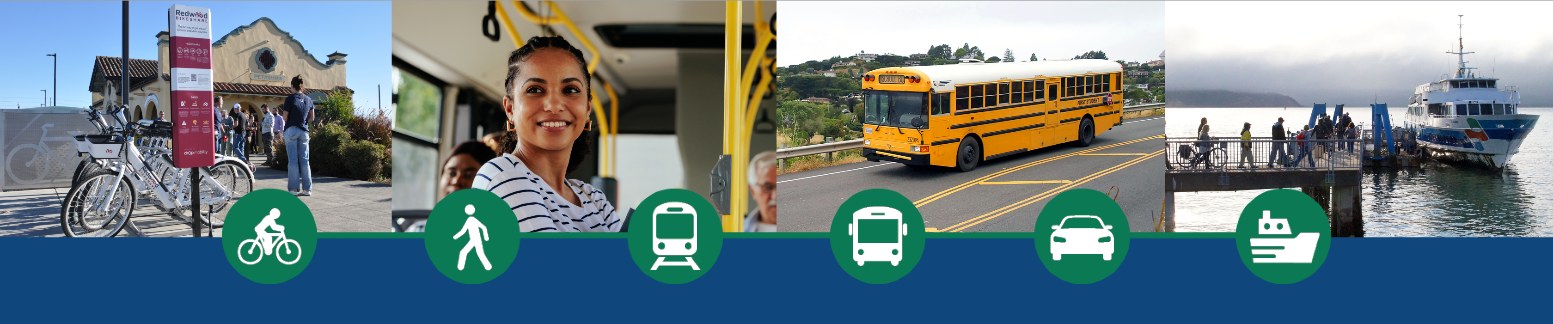
TAM is working to reduce vehicle trips and increase the number of alternative travel options throughout Marin County. These alternative options may include providing shuttles to ferry terminals and additional links between residential communities and transit stations. The goal of reducing vehicle trips is associated with improvements in air quality, noise pollution, street safety, and greenhouse gas emissions reduction. Thus, decreasing vehicle trips has potential benefits for Marin’s quality of life and environment.
Strategies to help reduce trips made by cars may include, but are not limited to:
- Improving access to vehicles (e.g., carshare, ride-hailing subsidies)
- Increasing first/last mile connections to transit (e.g., mobility hubs, bike and scooter share systems, shuttle and van services)
- Prioritizing land use strategies/transit-oriented development
- Making transit service improvements
- Encouraging employer-sponsored trip reduction strategies (e.g., remote work options, carpooling program, transit subsidies)
- Developing pricing strategies (e.g., fee-based VMT mitigation/banking programs)
Public feedback is helping to identify opportunities to improve travel options in Marin County, establish priorities, and develop strategies to reduce car trips.
As part of this study, TAM conducted a survey designed to gather insights into travel behaviors within Marin County and the surrounding region. The survey of 536 Marin County residents, employees, business owners, and visitors found strong demand for alternative travel modes, especially commuter rail and bus service. Results show that improved infrastructure is closely linked to a willingness to drive less, with many respondents open to changing travel habits if barriers are reduced. There is also broad support for transit-oriented development aligned with community priorities.
Overall, the findings suggest that investments in transit access, active transportation, and transit-oriented development could significantly reduce VMT and reflect strong public interest. Learn more survey insights here.
This study is funded by a California Department of Transportation (Caltrans) Sustainable Communities grant as part of Caltrans’ Sustainable Transportation Planning Grant Program.